
Power Calculator
Calculate electrical power for DC, single-phase AC, and three-phase AC systems.
Introduction.
Electrical power tells us how quickly an electrical device uses electricity during operation. It also helps explain the working characteristics of electrical appliances and equipment. Whether you are working with a small DC circuit, a single-phase AC supply, or a three-phase electrical system, calculating power correctly is essential.
Our Power Calculator is designed to make electrical power calculations simple and convenient. Instead of performing lengthy manual calculations, users can enter the required electrical values and calculate power quickly.
This Power Calculator is useful for students, electricians, and engineers who need quick electrical power calculations.
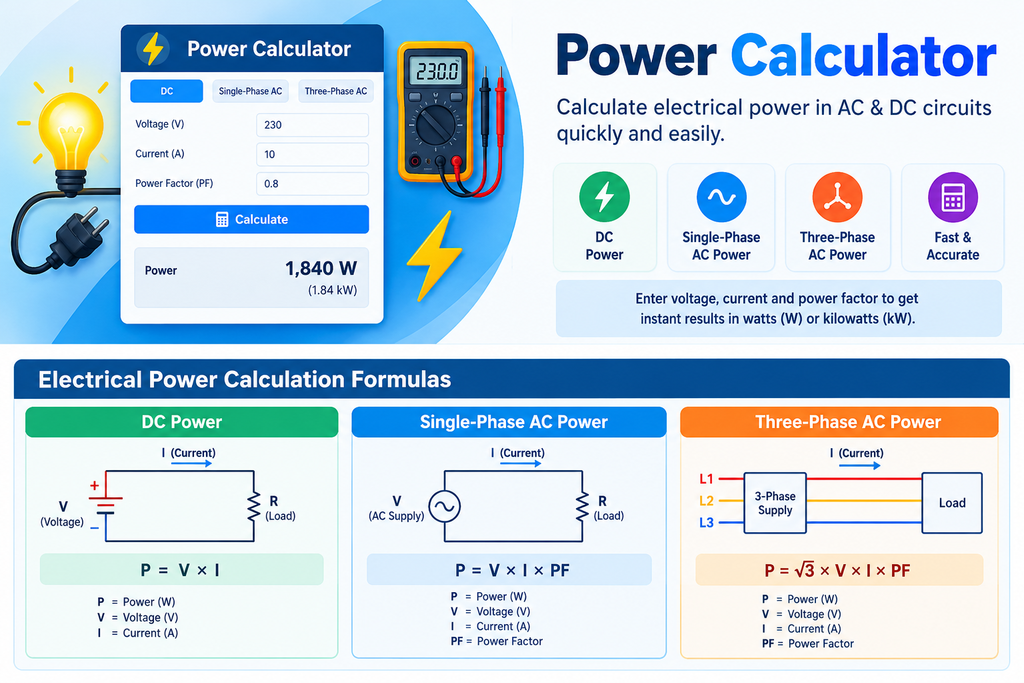
What Is a Power Calculator?
There is no doubt that the Power Calculator is a unique tool, packed with features, which calculates electrical power in an electrical system using voltage, current and power factor to calculate the power used by an operating device or electrical system.
Electrical power comes in two types: DC (Direct Current) and AC (Alternating Current). Engineers and electricians must understand that DC power is used to operate DC loads, while AC power is required for AC loads, a process that may also involve the power factor. The power calculation method depends on whether the circuit operates with a DC supply, single-phase AC, or three-phase AC. To simplify power calculations in electrical systems, this tool provides separate sections for AC and DC, making it easier for users to perform their calculations.
How to Use the Power Calculator
- Using the Power Calculator is simple. Follow the steps below to find the power consumed by an electrical load.
- Select the appropriate electrical system, such as DC, single-phase AC, or three-phase AC, if these options are available.
- Enter the required voltage in volts (V).
- Enter the current in amperes (A).
- Provide the circuit’s power factor reading in the corresponding field to continue with the calculation.
- Click the Calculate button to obtain the result.
- Check the result displayed by the calculator in watts (W).
Make sure all input fields contain the required values before starting a new calculation or clearing the entries. The accuracy of the calculated power depends on the accuracy of the information entered.
Electrical Power Calculation Formulas
Electrical power can be calculated using different formulas depending on the type of circuit and the available electrical values.
1. DC Power Calculation Formula
There is no power factor in DC power calculations; therefore, the voltage and current values are simply multiplied together.
Formula:
P = V × I
Where:
P = Electrical power in watts (W)
V = Voltage in volts (V)
I = Current in amperes (A)
Example:
Suppose a DC circuit operates at 12 volts and draws a current of 5 amperes. Calculate its electrical power.
Power = Voltage × Current
Power = 12 × 5
Power = 60W
the total result is : 60 watts.
2. Single-Phase AC Power Calculation Formula
For a single-phase AC circuit, real power depends on the supply voltage, current, and power factor.
Formula:
P = V × I × PF
Where:
P = watts (W)
V = voltage (V)
I = amperes (A)
PF = Power factor
Example:
For example, if a single-phase AC circuit operates at 230 volts, draws a current of 20 amperes, and has a power factor of 0.8, what is the resulting power?
Real Power = V × C × PF
V= Voltage
I= Current
PF= Power Factor
Power = 230 × 20 × 0.8
Power = 3680 W
To convert watts into kilowatts:
Power = 3680 ÷ 1,000
Power = 3.68 kW
The load has a real power consumption of about 3.68 kW.
3. Three-Phase AC Power Calculation Formula
In a three-phase AC circuit with balanced loads, the real power depends on the electrical supply voltage, flowing current, and power factor.
Formula:
P = √3 × V × I × PF
Where:
P = watts
√3 = Approximately value = 1.732
V = voltage
I = Ampare (A)
PF = Power factor
Example:
Suppose a balanced three-phase electrical system operates at 400 volts, draws 10 amperes, and has a power factor of 0.85.
Power = 1.732 × 400 × 10 × 0.85
Power = 5888.8W
To convert watts into kilowatts:
Power = 5888.8 ÷ 1,000
Power = 5.89 kW approximately
The power consumed is approximately 5.89 kW.
Understanding Watts and Kilowatts in Electrical Systems:
Electrical equipment power ratings are typically given in watts (W) or kilowatts (kW). They differ mainly in scale, with one kilowatt equal to 1,000 watts.
| Watts (W) | Kilowatts (kW) |
| 1 W | 0.001 kW |
| 200 W | 0.2 kW |
| 600 W | 0.6 kW |
| 1,200 W | 1.2 kW |
| 1,700 W | 1.7 kW |
| 3,000 W | 3 kW |
watts into kilowatts, divide the value by 1,000.
Formula:
Kilowatts = Watts ÷ 1,000
For instance, 4,000 W of electrical power is equivalent to 4 kW.
Factors Affecting Electrical Power:
The amount of electrical power used by a load is influenced by various operating conditions within the circuit.
Voltage
The electrical potential difference supplied to a circuit or across two points of a load.
Current
The current flowing through a circuit influences the amount of electrical power it uses.
Resistance
Resistance affects current and power in resistive circuits.
Power Factor
Power factor shows how efficiently electrical power is used in an AC circuit. It affects the current required by electrical equipment.
Frequently Asked Questions (FAQs)
1. What is a Power Calculator?
It calculates electrical power using electrical values.
2. How is electrical power calculated?
Power = Voltage × Current (DC).
3. Can users calculate both alternating current (AC) and direct current (DC) power with this online calculator?
Yes, of course. Our calculator supports both AC and DC power calculations.
4. How do I convert watts into kilowatts?
Divide watts by 1,000.
5. Who can use this calculator?
Students, electricians, and engineers.
6. Which units are used to express electrical power?
Watts (W) and kilowatts (kW).
7. Can it calculate three-phase power?
Yes, if three-phase calculations are supported.
Conclusion:
This Power Calculator helps users determine electrical power in DC and AC systems based on their requirements. It helps users understand the difference between watts and kilowatts, perform quick power calculations, and gain a better understanding of electrical power.